Pollination Standard – The following is the minimum standard for pollination strength required to rent a hive for pollination.
NSBA/WBPANS minimum standard:
4 frames of brood (100% coverage of equivalent of 4 frames)
8 frames of bees (100% coverage of equivalent of 8 frames)
2 frames of honey
1 laying queen
Please click here for sample Pollination Contracts [PDF]
Pollination Recommendations:
Suggested Hive Stocking rates for Fruit Crops:
Apples- 1 hive per acre
Cranberries- 3 hives per acre
Blueberries- 3 hives per acre
Raspberries- 1 hive per acre
Strawberries- 1 hive per acre
Pollinators and Roadsides
To Our Government and Business Leaders, Media and General Public,
The loss of honey bees and pollinators due to human influence is becoming an increasing concern. Honey bees and other pollinators are facing unprecedented challenges that pose serious threats to the sustainability of beekeeping operations and agriculture as well as the indigenous ecosystems that depend on them. Habitat destruction – destruction of areas populated with a diversity of indigenous wild flowers for forage – is one of these major issues. As Nova Scotians, the majority of us are well aware of the message that the canary in a coal mine provides. This letter is to inform government, business, the media and the public that it is in all of our best interests to heed the message of the pollinators: theirs and ours is a stressed environment.
Providing habitat for pollinators is a cost effective solution for businesses, agencies and individual property owners. One hundred years ago, lawns, graveyards and rifle ranges were covered with wild flowers and were mowed by sheep and cows. Today, at significant cost in labour, fuel and equipment maintenance, these spaces look like golf greens. For pollinators, this is the epitome of a green desert. For those incurring the costs associated with mowing, financial costs could be lowered or eliminated by reducing the amount of grass cut. In the case of some venues such as rifle ranges and ditches, income could be generated by allowing farmers to turn green growth into hay. Through these examples, it is clear that providing natural habitat for pollinators is cost effective. Simple management changes to how green spaces along roadsides, highway shoulders, rifle ranges, cemeteries, prisons, parks and other crown land could be of substantial benefit to bees and other wild pollinators. Implementing these strategies would also save money for taxpayers, business and home owners. Attached to this letter you will find a useful table filled with facts and cost effective strategies that will help provide our pollinators with much needed habitat.
Seed Mixes
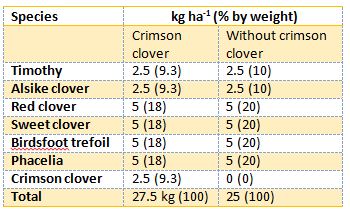
The seeding rate is 25 kg (1 bag) per hectare (2.5 acres). In order to get the best results, it is important to plant the mix in the spring. The Phacelia blooms in the first summer, followed by the crimson clover in the late summer and the sweet clover blooms the following spring/summer. Alsike clover, red clover and birdsfoot trefoil should continue to bloom for several years.
Alternatives: Triple Mix (red clover, alsike clover and timothy), which you can purchase from a variety of farm suppliers.
You can rely on the fact that neighboring properties may have pastures or hayfields with legumes or you may have native or naturalized plants (vetch, brambles, wild roses, asters, goldenrod, etc.) that provide high quality pollen and nectar for bees.
The seed mix above was ordered from Speare Seeds, Ontario.